The Story of Alpino Fiorelli
Story by Vic Galante - Research by Cynthia Galante - Published in August 2017
Coming to America
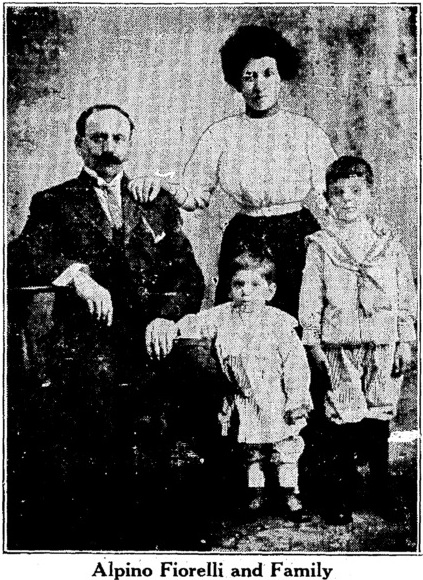
Alpino Fiorelli, age 36, departed his birthplace of Ferentillo, Italy, and arrived in America in October of 1905. Ferentillo is located in the Province of Terni, in the Region of Umbria, known as the "Green Heart" of Italy. It's a quick 12 minute drive north of Torre Orsina along Strada Provinciale 209. He was meeting his cousin, Enrico Spera, at 721 Whittaker Avenue in Trenton, New Jersey, who had paid for his ticket. Alpino had married Maria Depasqua, of Lanciano, Italy, in the Region of Abbruzzo. One year after arriving, Maria gave birth to a son which they named Salvatore. Four years later, in 1910, they welcomed their second son, Dante. From all accounts, the couple was happily married.
Family Ties
My great-grandfather, Mariano Spera, was born in 1872 in Scheggino, Italy -- a 16 minute drive north of Ferentillo further along Strada Provinciale 209. He married Luisa Palmieri, also of Scheggino and 3 years his junior. In 1901 Luisa gave birth to their first child, a daughter they named Anita. The couple traveled to America in 1902, but returned to Italy shortly thereafter. While back home in Scheggino, the couple gave birth to their first son, Alfonso, on May 24th, 1909. Mariano returned to America from Scheggino in February 1910, where he was soon joined by Luisa and their two children. He would now make Trenton, New Jersey, his home. Then, on December 7th, 1914, Luisa gave birth to their third child, Gina, my grandmother. Mariano found work as a "spooler" at the Roebling Wire Mill -- founded by John Roebling, who earned his engineering degree from Rensselaer Polytechnic Institute (RPI), in Troy, New York, and went on to design and construct the Brooklyn Bridge, among other civil engineering projects.
Mariano's younger brother, Enrico (born in 1881), had arrived in America two years prior, on September 18th, 1908, at the age of 27. His older brother, Luigi (born 1877), had arrived in America in March of 1906 at the age of 29.
Mariano Spera, along with his brother Enrico Spera, were first cousins to Alpino Fiorelli.
Murder
On Tuesday, February 2nd, 1915, Maria Fiorelli was shot to death on Swan Street by her husband. Police are on the lookout for Alpino Fiorelli: age 46, 5'10", 170lbs, dark hair, dark complexion, dark eyes, smooth face, with a mole on the right side of his face near the mouth. The fugitive was last seen wearing a cap and a light jacket. A reward in the amount of $250 has been placed on his head by Prosecutor Devlin.
Alpino Fiorelli was no stranger to the law. In December of 1914, Alpino was fined $5 by Judge Naar for shooting his .38 caliber revolver at some men in front of his home on 14 Butler Street. Several days later, on December 14th, he was in front of Judge Naar once again, this time for beating his wife, who he believed was unfaithful. Alpino was sentenced to 6 months in a work house. His friends secured a lawyer on his behalf and he was released on January 23rd, 1915.
One week later, on Saturday, January 30th, Alpino called Judge Naar asking him to arrest his wife, Maria, along with Attilo Condelora of 808 South Clinton Ave. The two were having an illicit affair. Alpino was accompanied by his son, Salvatore, age 9, who witnessed the wrongdoing. Judge Naar saw insufficient evidence and did not call for the arrest. As Alpino was leaving the court, he declared that he would take the law into his own hands and inferred, "I'll fix her." He went to a saloon where he was heard to repeat these threats.
Three days later, on February 2nd, he hid behind some old boilers in an open lot and awaited the coming of his wife who worked at the Enterprise Cigar factory. Robert Hennessey, an employee of the Roebling Boiler Shop on Swan Street, and Otto Brandt, employed at the Seidenberg Cigar Company, heard the shots and hurried to the scene. Maria was found dead when they arrived.
They notified Sgt Kelly of the Trenton Police. Captains Dettmar and Clancy, Detectives Blaugh and Heher, and Patrolmen Delouie and Pege, were all called to the scene. Prosecutor Devlin and Chief Kirkham searched for evidence. Delouie found a letter left by Alpino Fiorelli. The letter requested that his jewelry be sold to support his two children, Salvatore, age 9, and Dante, age 5.
Maria Fiorelli's body was moved to Taylor's Morgue where county physician Scammell was called to examine the wounds. He concluded that Maria was shot five times and died instantly. Maria's body was placed in the morgue. Funds are unavailable to save her from a pauper's grave. Her children were left to the care of family members while the police sought her husband. Coroner Bray hopes that someone will fund a decent burial, even if it's her husband. The body will be held until Sunday at which time it will be carried to the pauper's grave. Maria was laid to rest on February 6th. Four friends followed her remains to Greenwood cemetery. Money was donated. No religious service was held. The children did not attend. Peter Depasqua, the deceased's brother, made arrangements for the funeral.
The police believe that since Alpino made threats to his wife prior to the crime, he had planned the murder and was in hiding. It is believed that he's hiding in the home of a friend. Chief Cleary issued several hundred circulars with Alpino's description and a reward of $250. The posters also stated: "Alpino, native of Ferentillo, Italy, may have a moustache and several days growth."
The couple seemed happily married until Maria deserted her husband. Alpino was willing to reunite even after being sent to the workhouse and knowing of her lover, Attilo Condelora. Maria refused. Driven to desperation, he planned the murder. Authorities believe that he is still hiding in Trenton.
Captured
Police suspect that Alpino is being harbored in the local Italian community by family and friends. Surveillance is put in place and police were tipped when a suspicious man hired a taxi late in the evening of February 4th, to go to New York City. With guns drawn, Alpino Fiorelli was taken into custody in Englishtown as the manhunt ended peacefully only two days after the murder.
Police also arrested Attilo Condelora, Maria's suspected lover, who was held in the Mercer County jail only a few cells from Alpino.
Six other men were picked up by police and held on charges of aiding and abetting. They included: Mariano Spera of 37 Emery Avenue, Enrico Spera of 528 Hudson Street, Peter Bianchi of 154 Washington Street, Tony Deangila of 209 Mott Street, and Alfredo Torlini of 442 Whittaker Avenue. Enrico Spera, cousin of Alpino, was branded by Capt Dettmar as the leader in the case to shield Alpino. His bail was fixed at $3,000.
Mariano Spera was given a hearing on February 6th by Judge Naar charged with aiding, concealing, and giving money, clothing, and shelter to Alpino. He was also charged with assisting the murderer to escape. Mariano plead not guilty through his interpreter, Father Vincent Serafini, but added that he had collected $20 from three friends of the prisoner to help him escape. Bail was fixed at $2,000.
Detective Sergeant Charles Pilger threw some light on the arrest. Pilger said, "When information came to me that a taxicab was wanted in the Italian section, I concluded that the effort was made to get his two children out of the city. I thought that the destination might lead to the whereabouts of the murderer, so we followed the cab. We trailed it thinking that the children were in it, until Mr. Gilmore, the cab owner who accompanied his driver on the ride, gave the driver the signal to turn into Englishtown. I ordered our man to drive alongside the cab. The man in the cab was Alpino Fiorelli." Investigation showed that Fiorelli gave up his position with the Italian government in Italy, where he was employed in the Customs Department, and was lured to America's shores by the promise of "plenty of gold". He found, upon arriving, that he had to work just as hard as in the old country. Undaunted, he married and lived peacefully until Attilo Condelora came into their lives. This was the beginning of the lovers' triangle that ended in murder.
Attilo Condelora had a sweetheart, but promptly dropped her upon seeing Maria Fiorelli. One night, regardless of the presents of her husband, Alpino, he proceeded to a window to serenade Maria. The indignant husband went to the window with a revolver and was about to shoot Condelora when Maria interfered. Condelora's sweetheart, upon learning of this, became enraged with jealousy, and told Alpino how unfaithful his wife was. Alpino then beat his wife and was sentenced to the workhouse. After being released, he discovered that Maria was boarding in the same house as Condelora. Upon meeting her on Swan Street he rebuked her and asked her to come home. She refused. It was then, out of desperation, that Alpino pulled the revolver and shot her in the back. He was exalted as this is the way a dishonorable person should be punished in his country.
Alpino's two children were found at the home of Mariano Spera on 37 Emery Ave. Spera was placed under arrest Saturday afternoon for trying to protect the slayer and aiding him in trying to escape the state. On February 7th, fearing that his children would be left without proper care while he was awaiting trial, Alpino signed papers in the County Jail turning over the youngsters to Father Edward Griffin of St. Joachim's Italian Catholic Church, giving him permission to have the children placed in an institution.
Trial and Sentencing
On February 26th, Alpino Fiorelli enters a plea of not guilty of first degree murder before Supreme Court Justice Thomas Trenchard in Mercer County. Because his friends were unable to raise funds to hire a lawyer, the court appointed John Kafes, who formally entered the plea. Monday, March 22nd, was set as the day of the trial. Sheriff Flemming drew a panel of 48 potential jurors in the presence of Judge Gnichtel.
Day 1: Six jurors were selected during the morning session. Alpino looked broken and red-eyed -- biting his handkerchief and rubbing his eyes. By the afternoon, all 12 jurors were selected. To keep the courtroom from becoming overcrowded, constables guarded the stairwells and only authorized personnel were admitted. Prosecutor Devlin is conducting the state's case.
Day 2: Guilio Giovannetti, the taxi driver, testified that Alpino confessed that he committed the crime. Giovannetti acted as interpreter at the police station the night of the capture. He said that he questioned the defendant about the murder at the request of the police officials. Alpino told of meeting his wife on Swan Street and asked her, "What are you going to do, keep up what you're doing?" The wife replied, according to the witness, "I don't want to have anything to do with you." Alpino said he shot his wife four times and walked away. Giovannetti further testified that Alpino showed him the revolver and acknowledged that it was the weapon he used. The prosecution went on to show that the murder was premeditated. The jurors are being quartered at Hotel Barlow on South Clinton Avenue.
Day 3: Sobbing loudly and biting his handkerchief, Alpino took the stand. He said that the wrongdoings of his wife drove him to shoot her on February 22nd. He broke down repeatedly and told the story with great effort. Alpino said he saw her leave the house and followed her. He called to her and said, "Maria, will you still be obstinate?" She replied, "Go out of here". The defendant said, "Do it for the love of the children." He had asked his wife to come home and that they would agree to separate. He said he would give her money to return to Italy. She turned and spat in his face. Alpino's 9 year old son, Salvatore, then took the stand. He testified of witnessing wrongdoing by his mother. Upon leaving the stand, Alpino gave his boy a Bible printed in Italian. Patrolman Delouie testified that Attilo Condelora also carried a revolver.
Day 4: The case was handed to the jury at 12:20pm. They deliberated for two hours. Alpino was found guilty of murder in the first degree. The sentence would be passed later.
Day 5: Alpino Fiorelli was sentenced to death via the electric chair sometime during the week of May 3rd. Alpino took the verdict coolly but when the sentence was interpreted to him by Father Vincent Serafini, he broke down and wept bitterly. Within two hours after sentence, he was placed in the condemned men's row at the prison. Counselor Kafes stated that he will take his case to the Court of Pardons, believing that his client should not endure the death sentence. The trial demonstrated the growing sentiment against capital punishment. When the jury was being drawn, Judge Trenchard had to dismiss several jurors because of their opposition to the death penalty.
April 9th: Friends of Alpino are endeavoring to save the man's life. Petitions were circulated to commute the death sentence.
April 27th: The Court of Pardons commuted the death penalty to life in prison. It was shown that his wife had a lover, was unfaithful, and goaded him into anger.
May 8th: Alpino received his first visit from his two sons at the prison. Visits from friends and relatives were denied to him while previously in the death house.
May 28th: The court's attention will now shift to the half dozen men who were accessories to the murder. All six defendants entered pleas of not guilty, including Mariano and Enrico Spera.
June 9th: The first two men had their day in court. Fredrick DeSantis was charged with hiring the taxi. The following day, the jury found him guilty with a recommendation of mercy. He was given a sentence of 1-3 years in prison. Peter Bianchi changed his plea to no contest. It's a misdemeanor for any person to hide a crime or assist a murderer. It was common for relatives and friends to assist criminals in Mercer County and laws must be enforced to prevent it. These men would be made an example.
June 14th: Alpino was brought to court to testify against Antonio Deangelo for aiding and abetting his escape. Antonio changed his plea to no contest. The plea ended the trial. The three other defendants, including Mariano and Enrico Spera, have now all retracted their pleas of not guilty to pleas of no contest.
July 2nd: Peter Bianchi, Antonio Deangelis, Alfredo Torlini, Mariano Spera, and Enrico Spera, after all had changed their pleas from not guilty to no contest, were each sentenced to 1-3 years in state prison by Judge Marshall in Mercer County -- the highest penal sentence allowed under law. The men expected a much lighter sentence. Torlini collapsed. His wife became hysterical and was given medical aid. Two other men broke down in jail and wept bitterly. Judge Marshall called attention to the fact that the charges were serious and accomplices should be punished accordingly.
July 8th: Incarcerations began as the men were taken to prison. Their earliest possibly release date would be July 7th 1916. Mariano's wife, Luisa, would be left to raise their three children, Anita (age 14), Alfonso (age 5), and Gina (age 7 months), while he served out his sentence.
November 16th: Pardons are being asked for all six accomplices in the Alpino Fiorelli murder case.
April 12th, 1916: All six men were given parole and released after serving 9 months and 5 days in prison.
A Sad Ending
December 3rd, 1921: Using bedclothes to make a rope, Alpino Fiorelli, now 51 yrs old, tied one end to the bars at the top of his cell, tied the other end around his neck, and jumped from his cot. He was dead when a deputy discovered him. He had, until recently, held the position of prison butcher. He had become despondent after losing that position. His two surviving children, Salvatore and Dante, are at present in a orphanage.
Note: It's doubtful that the two children remained in the orphanage long. According to the 1920 census, Salvatore Fiorelli, age 13, is listed as a servant in Buena Vista, NJ. And his brother, Dante, age 9, is also a servant in Buena Vista, though not in the same house.
The Family Tree
Mariano Spera died on October 6th, 1949, at the age of 77. His wife, Luisa, lived the rest of her days in Trenton and died on May 3rd, 1965, at the age of 90.
Anita, their oldest child, married Joseph Nicolai. They had one son, Remo (Ray), in 1926. Anita passed away at the age of 34 in Trenton, while her husband, himself born in 1896 in Italy, died on January 19th, 1985, in Trenton. Remo wed Esther Ann. He passed away in March 24th, 2013, also in Trenton. Esther may still be alive.
Alfonso (Al), their middle child, went on to have four children: Albert, Richard, Anita, and Joni. He died on January 29th, 2001, in Trenton at the age of 91.
Gina, the youngest child, married my grandfather, John Masserini, on September 26th, 1937. They went on to have 4 children: Mary Elizabeth (my mother) in 1940, Louise Anita in 1946, Eugene in 1950, and Patricia in 1952. John was 85 years old when he passed away on July 11th, 1996, and Gina was 90 when she passed away on December 9th, 2004.
On May 4th, 1963, Mary married my father, Tony Galante, and exactly 9 months to the day they gave birth to their first child, Victor Anthony (me). This was followed very quickly by Mary Angela (12 April 1965), Gina Louise (20 December 1966), and John (5 March 1968). After a four year hiatus they welcomed Anthony (23 January 1972) and then Toni Marie (8 August 1978). All six children were raised in West Paterson, New Jersey (now known as Woodland Park). They now reside in Jackson, NJ.
On June 2nd, 2001, I married my amazing wife, Cynthia Marie Heroux. We live in Navarre, Florida, where we are content to end this branch of the family tree. We hope that you enjoyed reading this story.
A lot of research went into unearthing this story. What you've read is just a summary of the events as they unfolded. Want to read the actual newspaper clippings? See the ship manifests? Look into the 1920 census data? We've pulled together all 49 documents, each in PDF formats for easy reading. Click here to continue exploring The Story of Alpino Fiorelli: Research Documents.